




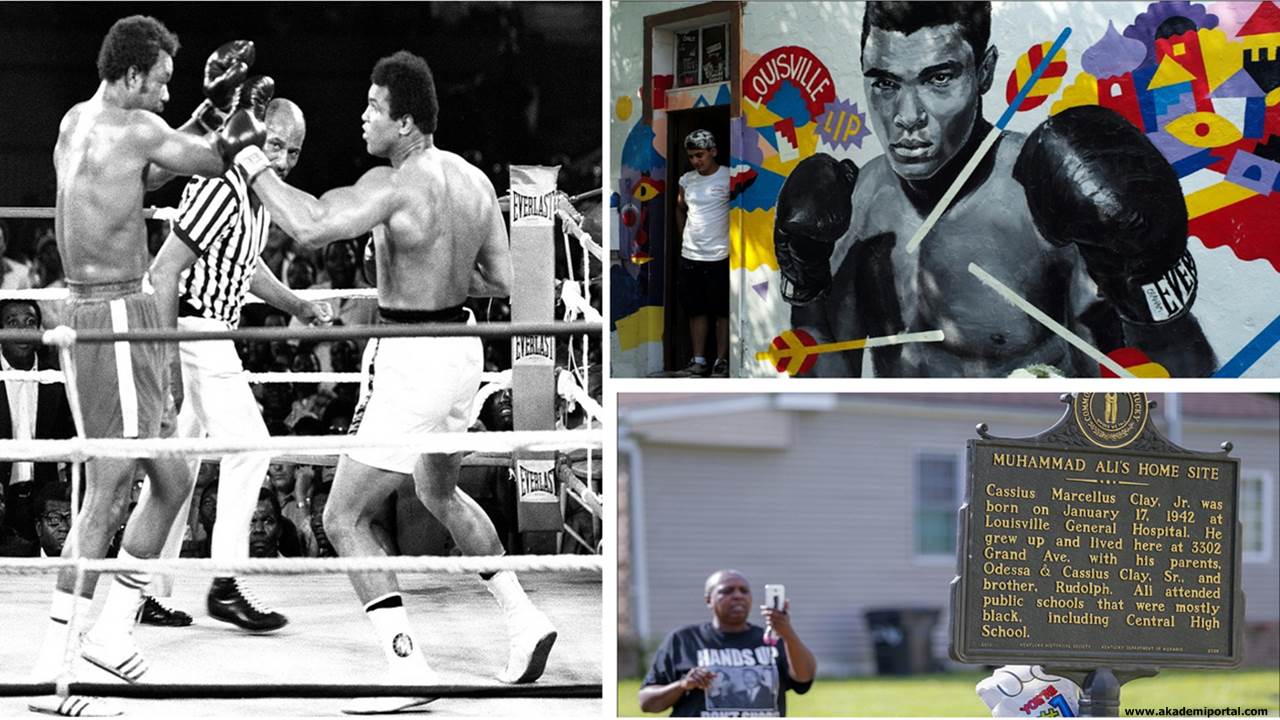
‘The Greatest’ comes home: Muhammad Ali’s body arrives in Louisville as hundreds flock to his childhood home to pay tribute
- The three-time heavyweight champion and outspoken civil rights activist died on Friday night at age 74
- On Sunday, his body returned home to Louisville, where the boxing great will be laid to rest on Friday
- He was accompanied from Arizona, where he died, by his wife Lonnie, and other family members and friends
- Politicians, celebrities and fans are expected for a massive memorial service that Ali planned himself
- After a small family funeral, Ali’s coffin will be transported through the streets of Louisville, before a private burial
Muhammad Ali’s body has arrived in his hometown of Louisville – where he’ll be laid to rest as the city grieves the loss of its favorite son.
An airplane carrying the boxing great’s body arrived from Arizona, where he died, on Sunday afternoon ahead of a public funeral procession and service expected to draw huge crowds in honor of ‘The Greatest’ on Friday.
The private plane landed at Louisville International Airport around 4.30pm, WLKY reports.
Family spokesman Bob Gunnell says Ali was accompanied by his wife, Lonnie, and other family members and friends. He says the body was taken to a local funeral home.
The three-time heavyweight champion and outspoken civil rights activist died on Friday night at age 74 after health problems complicated by a long battle with Parkinson’s disease.
‘Our hearts are literally hurting. But we are happy daddy is free now,’ one of Ali’s nine children, daughter Hana, wrote on Twitter.
FROM TRAITOR TO TRAILBLAZER: HOW MUHAMMAD ALI BECAME THE MUSLIM WHO AMERICANS CAME TO LOVE

The death of Muhammad Ali has cost American Muslims perhaps their greatest hero, a goodwill ambassador for Islam in a country where their minority faith is widely misunderstood and mistrusted.
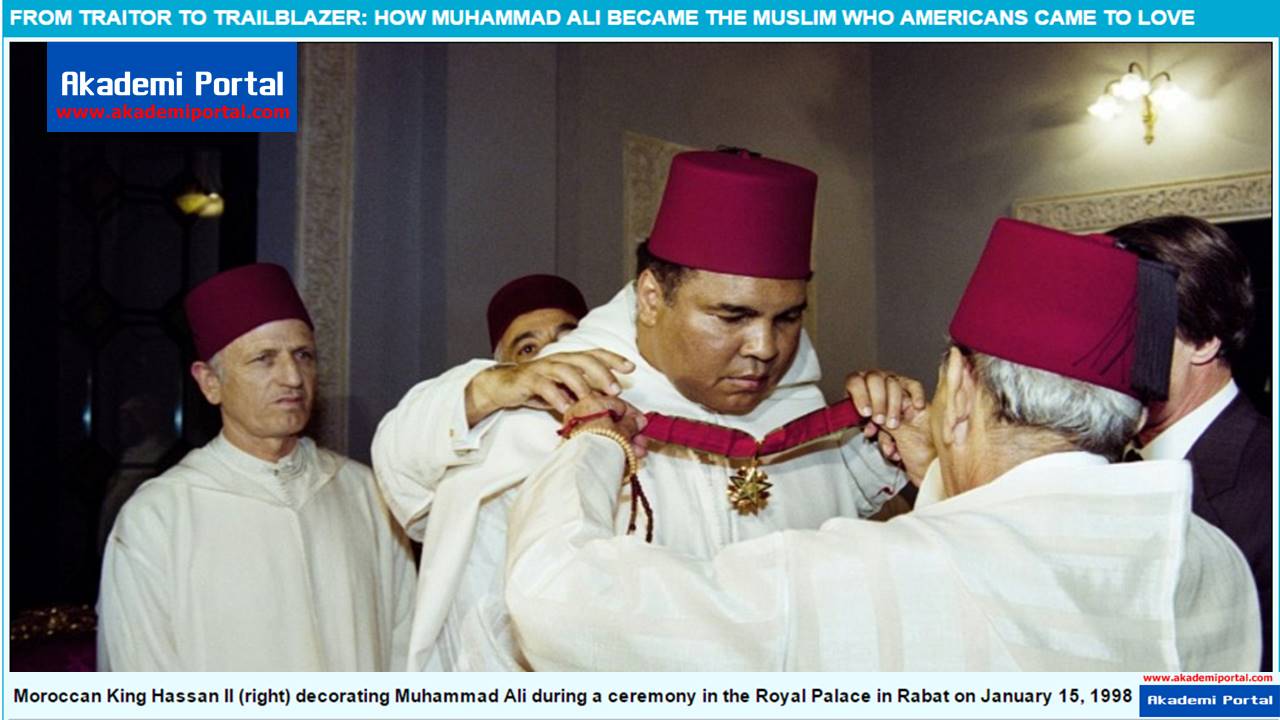
‘We thank God for him,’ Talib Shareef, president and imam of the Masjid Muhammad mosque in Washington, told a gathering of Muslim leaders who honored Ali in Washington on Saturday, a day after he died in a Phoenix hospital at age 74. ‘America should thank God for him. He was an American hero.’
From the turmoil of civil rights and black Muslim movements of the 1960s to the darkest days after Sept. 11, 2001, Ali was a hero that U.S. Muslims could share with part of the American mainstream.
Muslims remembered Ali for many familiar reasons, hailing him as a champion of social justice, a lifelong supporter of charitable works and an opponent of the U.S. war in Vietnam.
Moreover, they said, he was a Muslim that a largely Christian country came to admire, even if Ali shocked and scared much of U.S. society after he joined the Nation of Islam and changed his name from Cassius Clay in 1964.
‘When we look at the history of the African-American community, one important factor in popularizing Islam in America is Muhammad Ali,’ Warith Deen Mohammed II, son of the former Nation of Islam leader, said in a statement.
With some 3.3 million adherents in the United States, Muslims make up about 1 percent of the population, largely immigrants and African-Americans who have embraced the religion.
Although they have integrated into society better than some of their brethren in Europe, American Muslims face hardships even as the United State grows demographically less white and less Christian.
Since 2001, they have suffered backlash from those Americans who equate all Muslims with those who have attacked civilians out of some jihadist cause.
Decades before, black Muslim leaders such as Elijah Muhammad and Malcolm X rattled the white establishment as religious and ethnic minorities who demanded equality for their people. Elijah Mohammad preached a version that denounced white oppression and opposed integration of the races.
Ali came to be widely revered, but there was a time when he was rejected, mostly by whites by also by some black leaders for his bold statements against white supremacy and for his refusal to embrace the model epitomized by Martin Luther King, a Christian.
‘The sanitizing of Ali’s image in recent years has led many to forget that he was reviled by many during the 1960s for his conversion to Islam and for his refusal to be inducted into the U.S. armed forces,’ said Frank Guridy, a visiting associate professor of history at Columbia University.
‘He was seen as a traitor to the United States of America.’
In the 1970s, Ali converted to Sunni Islam, the largest denomination among Muslims worldwide, and embraced Sufism, a mystical school of the faith.
At the gathering of Muslim-American leaders in Washington, speaker after speaker remembered him fondly as the Muslim who Americans came to love.
Ali defended Muslims last December, after Republican presidential hopeful Donald Trump proposed temporarily stopping Muslims from entering the country in the wake of Islamist militant attacks in Paris and San Bernardino, California.
‘Our political leaders should use their position to bring understanding about the religion of Islam, and clarify that these misguided murderers have perverted people’s views on what Islam really is,’ Ali said in a statement.
He also used his influence to advocate the release of Jason Rezaian, a Washington Post reporter who spent 18 months in a Iranian prison, and for Daniel Pearl, a Wall Street Journal reporter who was captured by Islamic extremists in Pakistan and later beheaded in 2002.
‘Muhammad Ali was a gift from God,’ said Nihad Awad, executive director of the Council on American-Islamic Relations, ‘not only to Muslims but to the world.’
Source: Reuters
A mural shows Muhammad Ali, who was known as the ‘Louisville Lip’ in his hometown of Louisville, Kentucky
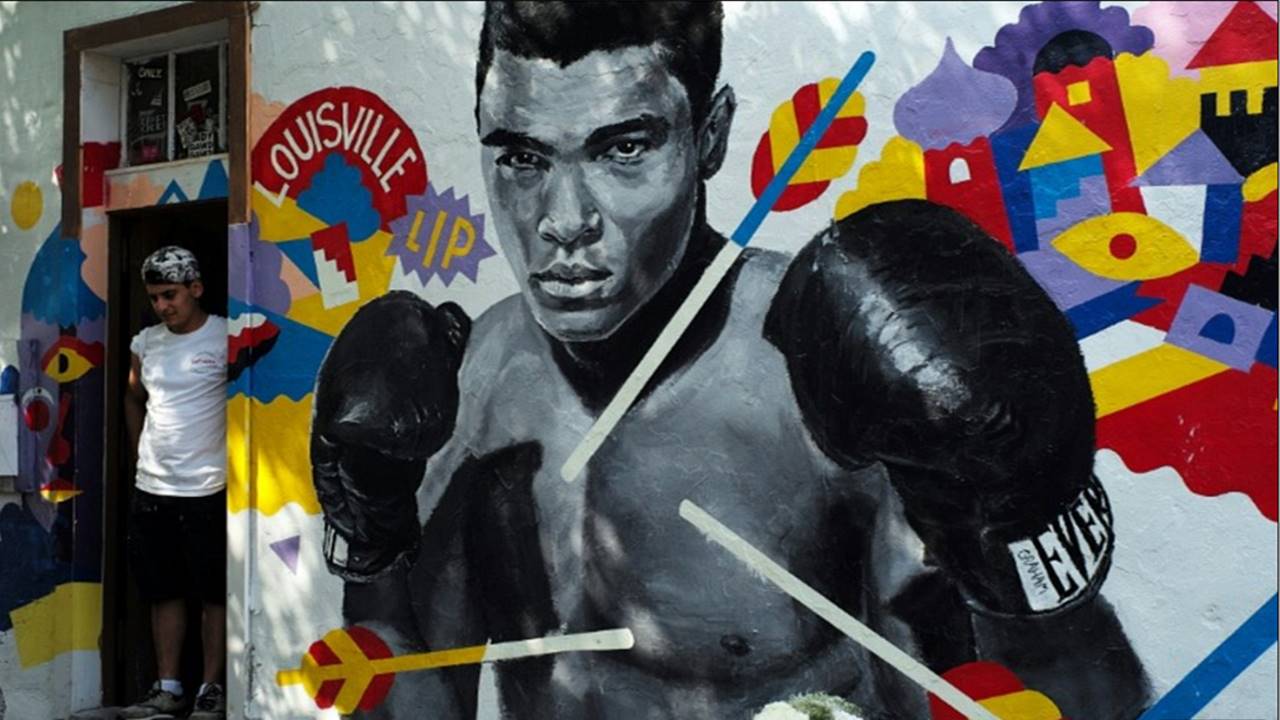
A mural of the late boxing legend Muhammad Ali is seen in his native Louisville, Kentucky, where he was born in 1942
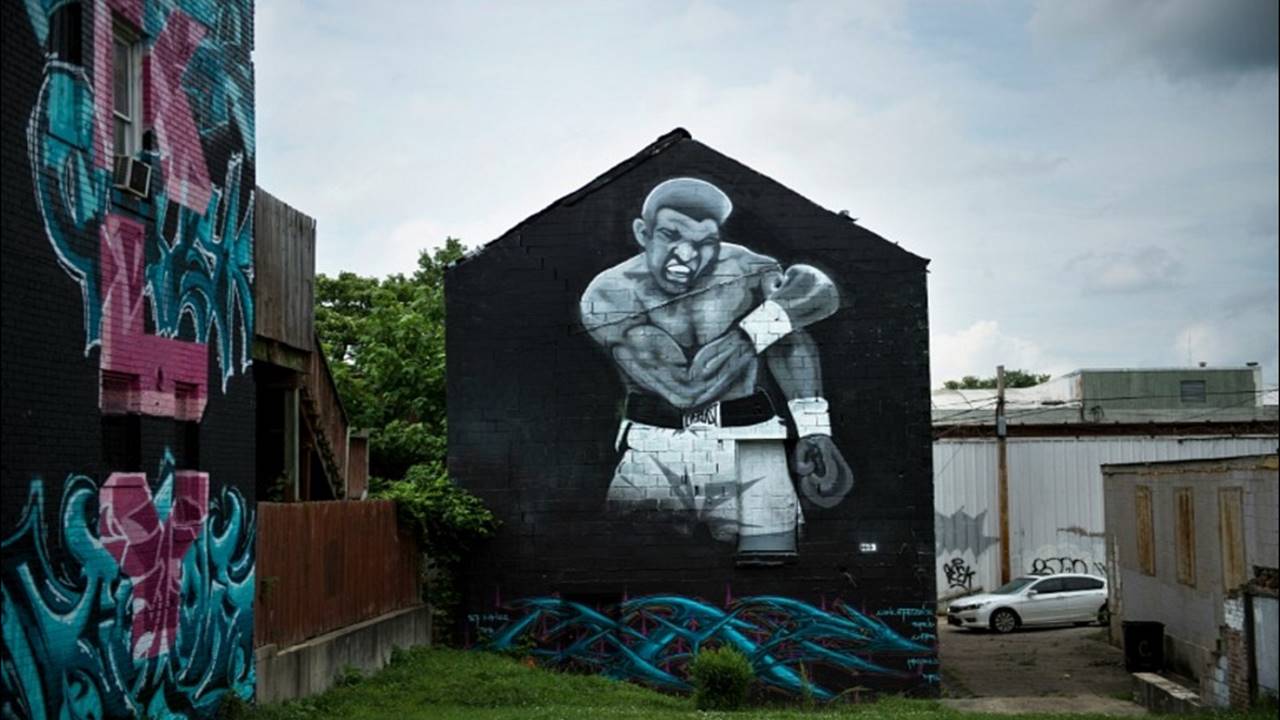
Louisville Mayor Greg Fisher orders all flags in Louisville to be lowered to half staff in honor of Muhammad Ali on Saturday
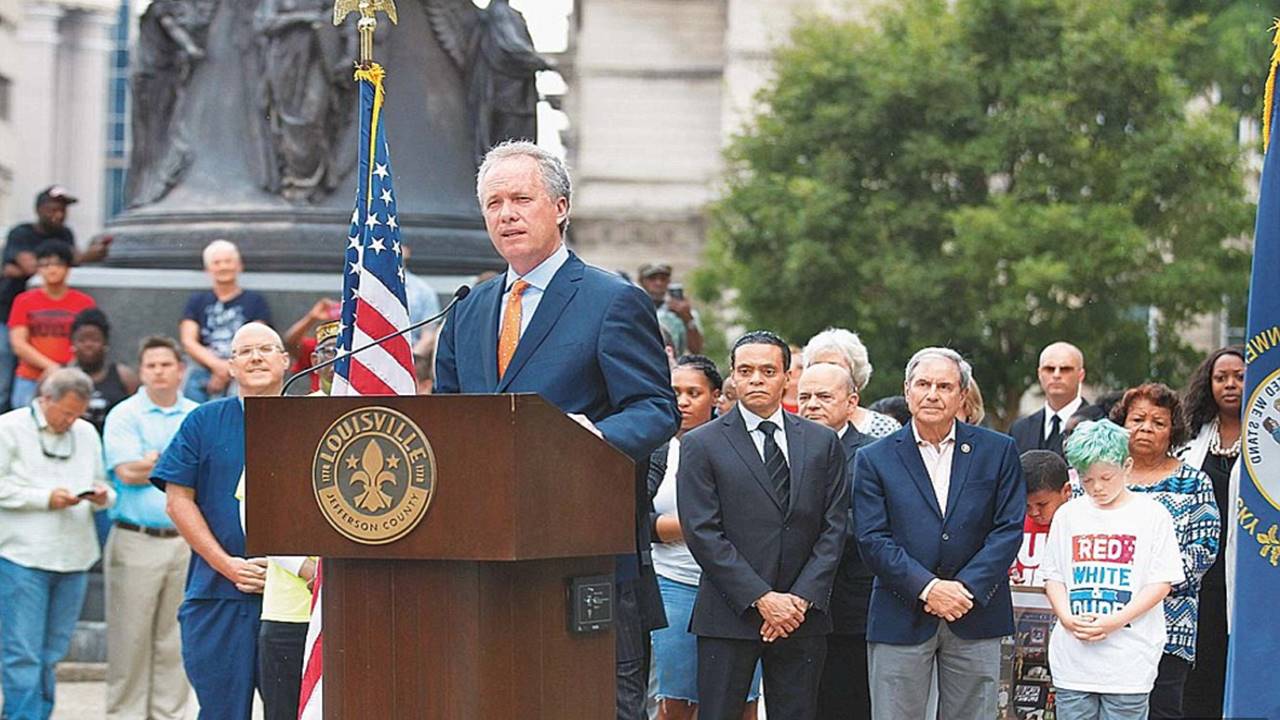
‘As a Muslim, I think it’s definitely important for us that we have such a person in the respected world that’s known to everybody, that gives us a good image,’ said Hamza Shah, a doctor in Louisville.
‘With the stuff going on these days, most of the time, you see in the media there’s a bad image of Muslims,’ Shah said.
‘The one person we can definitely get a good image of was Muhammad Ali, and he portrayed what the real Islam is.’
Since early 2015, attacks by Muslim extremists in Paris, San Bernardino, Brussels and elsewhere have fueled animosity among some Americans toward the Islamic world.
Republican presidential hopeful Donald Trump, now the party’s presumptive nominee, has seemingly co-opted that hostility for political gain. On Sunday, he suggested a Muslim judge could be biased against him in US courts.
Trump also sparked outrage at home and abroad in December when he suggested a temporary ban on all Muslims entering the United States.
But Ali, in a sharp rebuke to the Trump proposal, said: ‘We as Muslims have to stand up to those who use Islam to advance their own personal agenda.’
‘I believe that our political leaders should use their position to bring understanding about the religion of Islam, and clarify that these misguided murderers have perverted people’s views on what Islam really is.’
MUHAMMAD ALI (1942-2016)
Muhammad Ali was born Cassius Marcellus Clay Jr on January 17, 1942. He dazzled fans with slick moves in the ring and his wit and engaging persona outside it – and famously said he could ‘float like a butterfly, sting like a bee.’
He took the name of Muhammad Ali after converting to Islam in 1964, soon after he claimed the world title with a monumental upset of Sonny Liston.
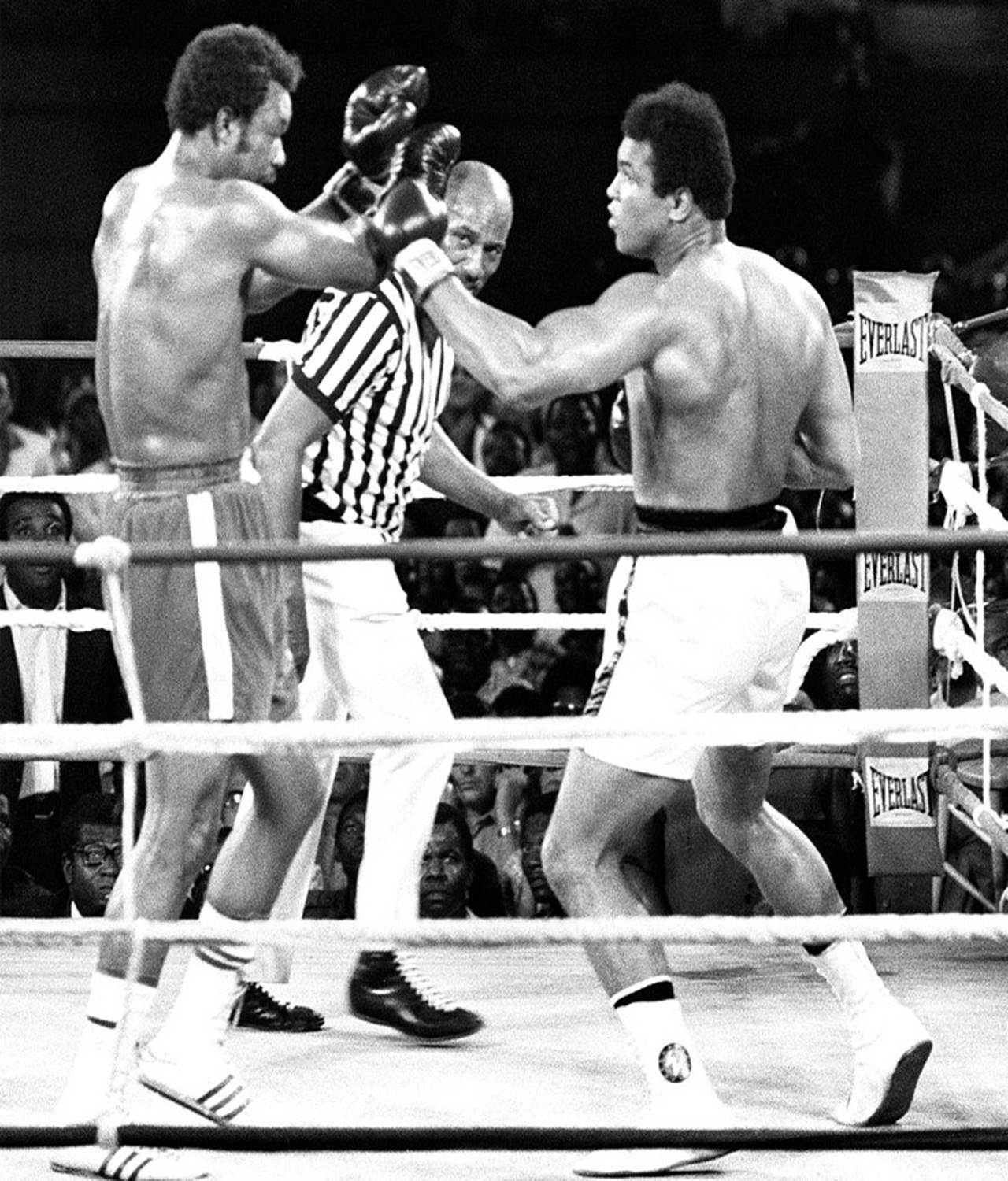
His career spanned from 1960 to 1981 and he retired with a record of 56-5, including such historic bouts as the ‘Rumble in the Jungle’ against George Foreman in 1974 in Kinshasa, capital of the Democratic Republic of Congo (formerly Zaire).
‘He hit me with a quick one-two, knocked me down to the canvas and my whole life changed,’ Foreman told CNN of the epic ‘Rumble.’
‘I was devastated,’ he said. ‘Little did I know I would make the best friend I ever had in my life.’
Ali’s refusal to serve in the Vietnam War saw him prosecuted for draft evasion, and led to him being effectively banned for boxing for three years of his prime.
But Ali held firm to his beliefs and eventually earned accolades as a civil rights activist. The US Supreme Court overturned his conviction for draft dodging in 1971.
He received the highest US civilian honor, the Presidential Medal of Freedom, in 2005 and was chosen to light the Olympic torch in 1996, his hands trembling due to Parkinson’s – a poignant moment for the sports world.

The famous 1974 Rumble in the Jungle between Muhammad Ali (right) and his compatriot and the titleholder George Foreman
This will be a continuation of the archive
Akademi Portal / Apnewsturk / YouTube / Yotube Channel
Facebook Hesabınız Üzerinden Yorum Yapın