




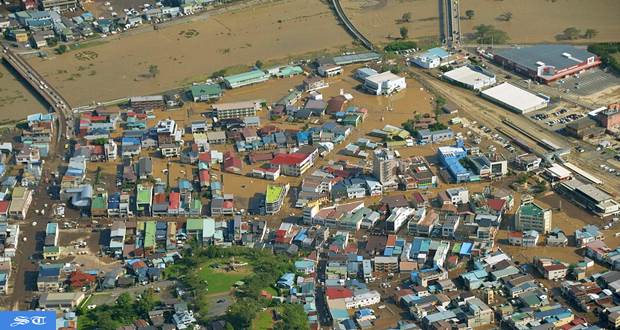
Nine pensioners are found dead in a care home for dementia sufferers as floods from 100mph typhoon sweep through Japan
At least nine elderly people have been found dead at a nursing home in Japan as heavy overnight rain from a devastating Typhoon left towns flooded across the country’s north.
Police discovered the bodies in the town of Iwaizumi while checking another facility in the flooded area.
Takehiro Hayashijiri, an official at the Iwate prefecture disaster management division, said the home was for people with dementia.
Footage from public broadcaster NHK showed a helicopter hovering over the building as rescuers tried to pluck other stranded residents to safety.
Media reports said the building was reserved for people with dementia and another 86 elderly residents and employees were in another facility building at the time.
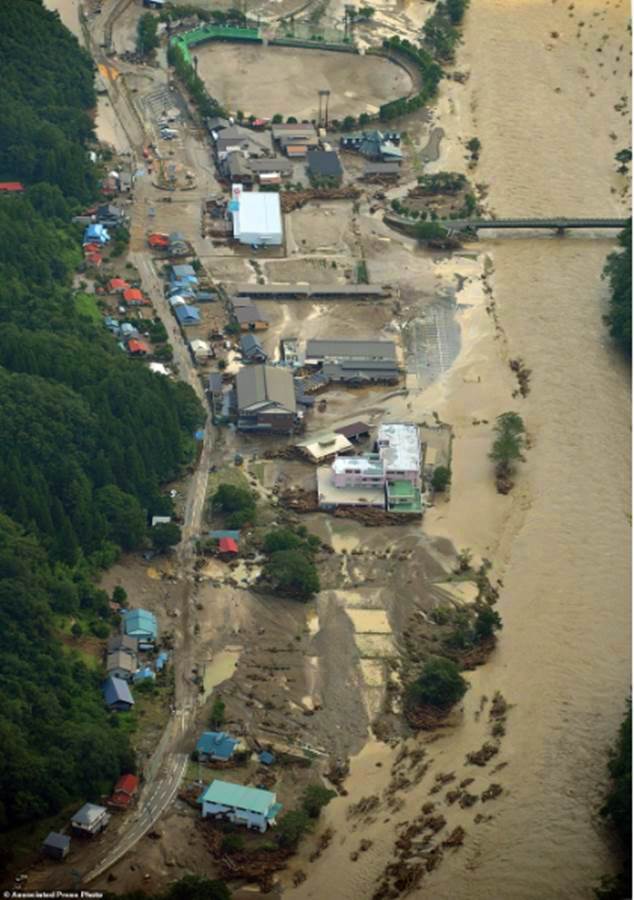
Footage showed the nursing home partially buried in mud, surrounded by debris apparently washed down from the mountains. A car by the home was turned upside down.
The death toll from the powerful storm rose to 11 after an elderly woman was found dead in her flooded home nearby, and another body was discovered not far from the nursing home, the Fire and Disaster Management Agency said.
‘We’re making a government-wide effort to assess the extent of damage,’ Chief Cabinet Secretary Yoshihide Suga told reporters.
The government sent the Self-Defense Force, Japan’s military, to help in the rescue and cleanup effort.
Further north, on the island of Hokkaido, at least two rivers broke through their banks.
The embankments gave way early on Wednesday morning, NHK said, quoting Japan’s Ministry of Land, Infrastructure and Tourism.
Authorities in the town of Minami-furano reported many people trapped in houses and shelters by flooding from the Sorachi river, NHK said.
http://dai.ly/x4r5fn0
The typhoon, with winds of over 100 miles an hour when it made landfall, also caused flooding on the northern island of Hokkaido.
The typhoon was later reclassified as an extratropical cyclone and moved out into the Sea of Japan at midnight, said the Japan Meteorological Agency.
The full scale of damage, however, did not become apparent until daybreak when rescue operations began in earnest.
In Hokkaido, the northernmost of Japan’s four main islands, one person who had been inside a car was missing in the town of Taiki, police and government officials said.

An aerial view shows a nursing home (centre), at a flooded area in Iwaizumi town, Iwate prefecture. Nine pensioners are believed to have been killed after mud slammed into the building
At least three cars fell into rivers in other towns on the island after bridges collapsed, they said, stressing it was not known how many people were inside the vehicles.
‘In Minamifurano town, the water level is still very high with a current, and rescue workers are using helicopters now to try to evacuate several people who are left on the roofs of their houses or their cars,’ said Hokkaido official Terumi Kohan.
Lionrock’s path — hitting northeastern Japan from the Pacific Ocean — was unusual.
Typhoons usually approach Japan from the south and southwest before moving northward across the archipelago.
Up to eight centimetres (three inches) of rain per hour fell overnight and authorities had warned of flooding and landslides.
The typhoon’s landfall came at high tide, which exacerbated the flow of water.
Lionrock comes on the heels of two other typhoons that hit Japan in the past nine days, resulting in two deaths, the cancellation of hundreds of domestic flights and disruptions to train services.
As of noon Wednesday it had combined with another similar storm in the Sea of Japan and was near the North Korea-China border, said Eiju Takahashi, an official at Japan’s weather agency.
The scene of large parts of northern Japan covered with muddy water was a shocking reminder of the major tsunami that struck the same region five years ago.
Iwate prefecture, the hardest-hit by the typhoon, is one of the areas still rebuilding from the March 2011 tsunami and earthquake, which left more than 18,000 people dead along Japan’s northeastern coast.
SourceTurk
Facebook Hesabınız Üzerinden Yorum Yapın