




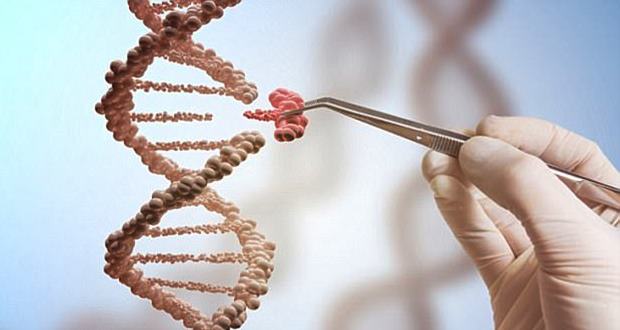
Scientists achieve first safe repair of gene mutation (Video)
Designer baby breakthrough after scientists use controversial gene editing technique to ‘fix’ embryos that would have developed heart failure in a world first
Each year, millions of people around the world are affected by diseases caused by mutations that occur in the very early stages of development.
But many of those diseases could soon cease to exist, thanks to a gene editing technique that uses the controversial CRISPR-Cas9 system.
In a world first, scientists have used the technique to correct a mutation for a heart condition in embryos, so that the defect would not be passed on to future generations.
The findings could pave the way for improved IVF outcomes, as well as eventual cures for some of the thousands of diseases caused by mutations in single genes.
Science: Scientists achieve first safe repair of gene mutation-AkademiPortal from Akademi Portal on Vimeo.
The work is a collaboration between the Salk Institute, Oregon Health and Science University (OHSU) and Korea’s Institute for Basic Science.
Professor Juan Carlos Izpisua Belmonte, an author of the study, said: ‘Thanks to advances in stem cell technologies and gene editing, we are finally starting to address disease-causing mutations that impact potentially millions of people.
‘Gene editing is still in its infancy so even though this preliminary effort was found to be safe and effective, it is crucial that we continue to proceed with the utmost caution, paying the highest attention to ethical considerations.’
In the study, the researchers were able to correct a mutation that causes an inherited heart disease, called hypertrophic cardiomyopathy (HCM).
HCM is an inherited disease of your heart muscle, where the muscle wall of your heart becomes thickened.
HYPERTROPHIC CARDIOMYOPATHY
Hypertrophic cardiomyopathy is an inherited disease of your heart muscle, where the muscle wall of your heart becomes thickened.
It is one of more than 10,000 inheritable diseases caused by an error in a single gene.
This genetic disease manifests only in adulthood and affects an estimated 1 in 500 people.
It can lead to heart failure and sudden death of apparently healthy people.
Q&A: EVERYTHING YOU NEED TO KNOW ABOUT CRISPR-CAS9
Q: What is Crispr-Cas9?
A: An incredibly powerful gene-editing tool that is transforming the way DNA is manipulated and modified. First demonstrated in 2013, it is based on a system bacteria use to defend themselves against invading viruses.
Q: How does Crispr-Cas9 work?
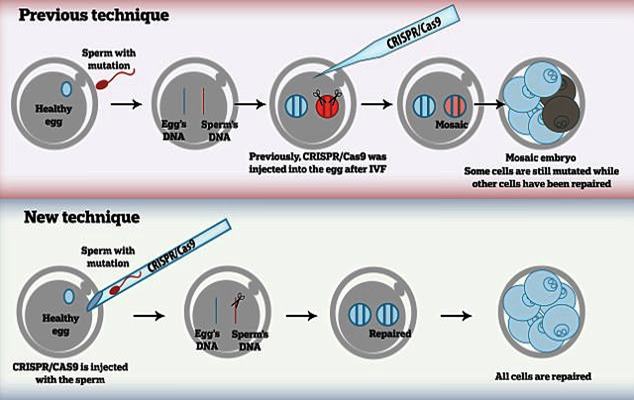
A: In its most basic form, the gene editing ‘tool kit’ consists of a small piece of RNA – a genetic molecule closely related to DNA – and an enzyme protein called Cas9.
The RNA component is programmed to latch onto a specific DNA sequence. Then Cas9 slices through the strands of DNA, like a pair of molecular scissors.
Q: What can Crispr-Cas9 do?
A: By cutting away precisely targeted elements of DNA, active genes can be switched off. Defective parts of a gene can also be removed, allowing the fault to be repaired.
Q: How are defective genes fixed?
A: Here, nature comes into play. Once a piece of DNA has been snipped out in a cell, natural repair systems kick in to try to repair the damage.
More advanced gene editing systems include additional ‘template’ DNA the cell can use to mend the break, making it possible to re-write the genetic code.
This was what the scientists conducting the new research planned to do. In the event, the embryos went their own way.
Instead of adopting the researchers’ template, their cells exploited the fact that only one copy of the gene – carried by sperm – was defective.
They based their repairs on the other, functioning, copy of the gene inherited from the women who donated their eggs for the research.
Q: Does this mean gene editing of embryos could eliminate inherited diseases?
A: A lot more research has to be done before the technique is shown to be safe and effective enough to be used in the clinic.
Also, altering nuclear DNA in a developing embryo is currently illegal.
A change in the law would be needed before such treatments can be considered, and this would involve addressing some profound ethical questions.
If in future gene editing of embryos is given the green light, it could potentially prevent thousands of diseases being passed onto future generations.
UK COULD BE THE FIRST COUNTRY TO APPROVE THE TECHNIQUE
The highly controversial technique is still at an early experimental stage.
There is no question of any attempt being made to create babies with the genetic modification, which would be illegal both in the US and the UK.
But a leading member of the team has hinted that first steps towards bringing the treatment to patients could take place in the UK under the direction of the fertility regulator the Human Fertilisation and Embryology Authority (HFEA).
Dr Shoukhrat Mitalipov, from Oregon Health and Science University (OHSU) in Portland, said in a telephone briefing with journalists: ‘Maybe .. (the) HFEA might take a lead on this, but I’m quite sure before these clinical trials can go on they have to go through, I believe, Parliament to change a law.
‘So there is still a long road ahead, particularly if you want to do it in a regulatory way.’
US regulatory barriers to such research are so high they could be insurmountable.
In the US, taxpayer funds cannot pay for research that destroys human embryos.
And Congress has banned the US Food and Drug Administration (FDA) from even considering the possibility of human clinical trials involving embryos with edited inherited genes.
More liberal Britain has already blazed a trail by becoming the first country officially to sanction mitochondrial replacement therapy (MRT), seen by some as opening the door to ‘designer babies’.
THE BACKLASH AGAINST CRISPR
Some people are voicing their opposition to the gene-editing technology.
Dr David King, director of Human Genetics Alert, said: ‘If irresponsible scientists are not stopped, the world may soon be presented with a fait accompli of the first GM baby.
‘We call on governments and international organisations to wake up and pass an immediate global ban on creating cloned or GM babies, before it is too late.
‘There is absolutely no medical need to use this technology to avoid the birth of children with genetic diseases, since genetic selection techniques can prevent their birth, where that is appropriate.
‘So scientists racing to develop this technology must be driven by something else: irresponsible technological enthusiasm, the desire for fame, or the financial gain of being the first to market designer babies.’
WHY CHARLIE GARD WOULD NOT HAVE BEEN SAVED BY CRISPR
Charlie Gard would not have been saved by gene editing his embryo in the way described by Dr Shoukhrat Mitalipov and his fellow scientists.
The technique worked for the heart failure condition hypertrophic cadiomyopathy because the disorder is due to a fault in a single gene inherited from one parent.
Charlie’s illness, infantile onset encephalomyopathy mitochondrial DNA depletion syndrome (MDDS) is an ‘autosomal recessive’ disorder, which only manifests itself if the gene fault is inherited from both parents.
The disease leads to a loss of mitochondrial DNA, housed in cellular ‘power plants’ that supply energy to vital organs.
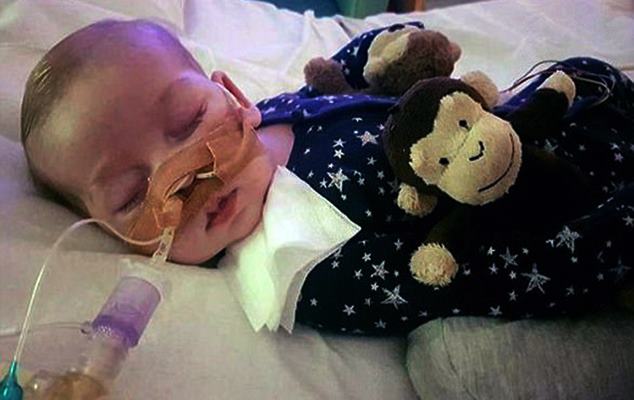
Because of the gene defect Charlie was unable to transfer energy to his muscles, kidneys and brain.
Although it affects mitochondrial DNA, the rare condition is triggered by a fault in the cell nucleus passed down by both a child’s mother and father.
The American researchers admitted that fixing such a ‘recessive’ genetic error caused by two mutated copies of a gene would be far more challenging.
This is because the repair they carried out depended on having one ‘good’ copy of the gene.
The scientists used a ‘molecular scissors’ technique called Crispr-Cas9 to snip away precisely targeted elements of defective DNA carried by fertilising sperm.
Once the dysfunctional DNA was removed, Mother Nature took over as the embryos’ own repair systems fixed the damage using the ‘good’ gene copy – inherited from the egg donor mothers – as a template.
Without the mothers’ functioning genes, it is unlikely the fix would have succeeded.
Although the scientists introduced their own healthy gene template, at the end of the day this played no part in the repair.
Charlie died on July 28, aged 11 months, after being at the centre of a painful legal battle between his parents and London’s Great Ormond Street Hospital.
[divider]