




Russia reveals hypersonic stealth bomber that can launch nuclear attacks from space: Radical plane could begin testing in 2020
- Test model of craft known as PAK-DA could fly in 2020
- Hypersonic engine for the craft believed to have been already tested
- Would be able to travel anywhere in the world in two hours
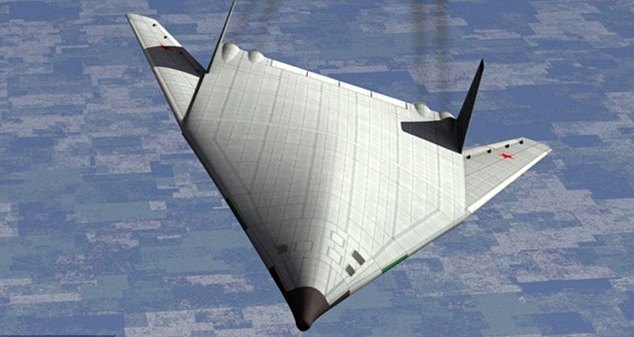
Russia’s next generation hypersonic stealth nuclear bomber could fly by 2020, it has been claimed.
Military bosses claim the engine for the craft has already been tested, and a prototype could take to the air in six years.
It would be able to travel anywhere in the world in two hours and drop a devastating nuclear warhead before returning to base, it is claimed.
Scroll down for video

Military bosses claim the engine for the craft has already been tested, and a prototype could take to the air in six years.
The test engine is expected to be showcased at the Army-2016 International Military Technology Forum, which is set to take place on September 6-11 in the Moscow Region.
Colonel-General Sergei Karakayev, commander of Russian Strategic Missile Forces, confirmed the model engine for the bomber has been built and successfully tested at the Serpukhovo branch of the Military Academy.
‘An engine for a promising space plane has been developed at Strategic Rocket Forces Academy,’ General Sergey Karakaev, RVSN’s commander, told reporters on Wednesday.
‘The unit’s operational ability had been proven,’ he said, according to The Observer.
‘The idea is that the bomber will take off from a normal home airfield to patrol Russian airspace. Upon command it will ascend into outer space, strike a target with nuclear warheads and then return to its home base.’
Colonel Alexei Solodovniko, the project’s general contractor as well as a professor of Strategic Missile Forces at the Military Academy, told RIA Novosti.
A prototype of a next generation Russian vbomber design being wind tunnel tested
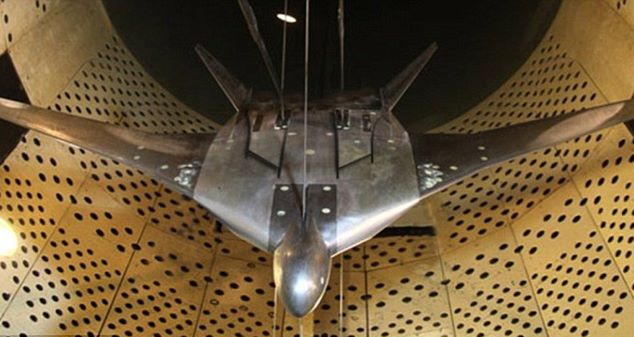
‘We are cooperating with Russia’s Central Aerohydrodynamic Institute on the design of an airframe and the aircraft’s characteristics.
‘I think that its lift-off mass must be 20-25 metric tons for it to be a strike aircraft. It will [be able to accelerate to] hypersonic speed in rocket mode,’ he added.
Two engines—one for the airplane and another for the spaceship—will be combined within the bomber’s engine setting.
According to the Academy of Strategic Missiles Forces, in plane mode, the engine will use kerosene fuel.
For space flight, it will use methane and oxygen.
British Reaction Reaction Engines says its hypersonic engine will also take to the skies by 2020.
The European Space Agency has invested $11 million toward the development of an engine that could one day allow aircraft to fly anywhere in the world in just four hours.
News: Russia’s new bomber will launch nuclear warheads from space from Akademi Portal on Vimeo.

———————————————————
British Reaction Reaction Engines says its hypersonic engine will also take to the skies by 2020.
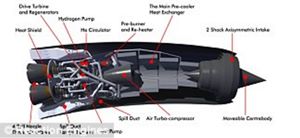
The revolutionary Sabre engine could allow aircraft to take off from a runway and accelerate to five times the speed of sound, before switching to a rocket mode, propelling it into orbit.
The Sabre engine works by burning atmospheric air in combustion chambers.
It then uses the heat to turbo-charge the engine.
At the moment, rockets have to carry liquid oxygen and liquid hydrogen to power them and the cost of carrying this heavy fuel is expensive.
The new engine creates its own liquid oxygen by cooling air entering the engine from 1,000°C to minus 150°C in a hundredth of a second – six times faster than the blink of an eye – without creating ice blockages.
This new class of aerospace engine is designed to enable aircraft to operate from standstill on the runway to speeds of over five times the speed of sound in the atmosphere.
It can then transition to a rocket mode of operation, allowing spaceflight at speeds up to orbital velocity, equivalent to 25 times the speed of sound.
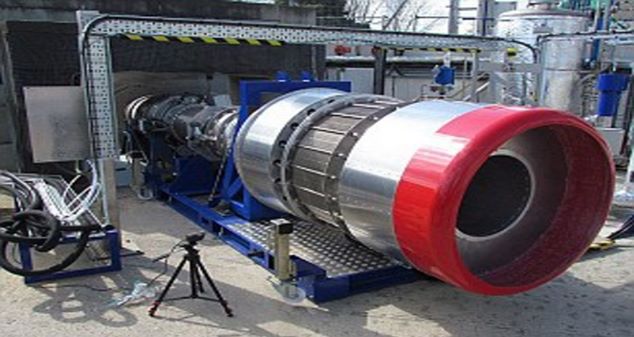
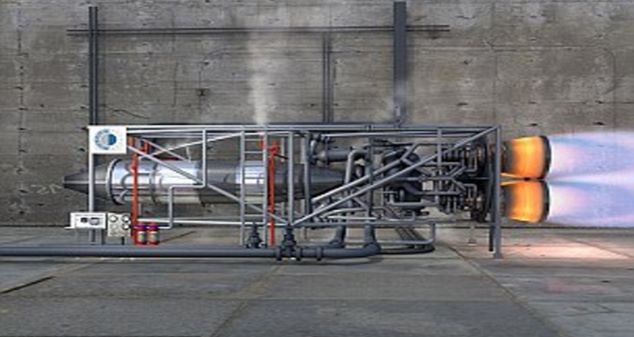
Oxfordshire-based Reaction Engines has been developing a turbine that combines both jet and rocket technologies to achieve rates five times the speed of sound.
According to the firm, the new agreement with the ESA and the UK Space Agency, along with the existing partnership with BAE Systems, means that the first ground demonstrator engine could be ready for testing by 2020.

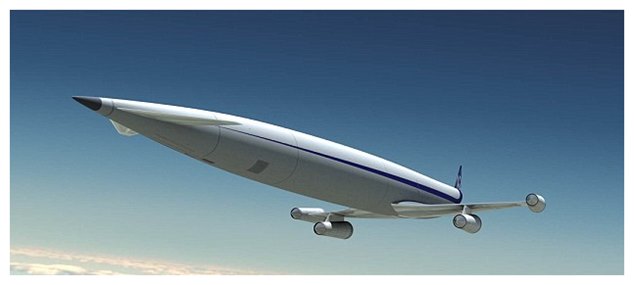
The European Space Agency has invested $11 million toward the development of a new type of engine that could one day allow aircraft to fly anywhere in the world in just four hours. Pictured, an artist’s impression of the Lapcat A2 craft flying at Mach 5.
Reaction Engines announced today that it has secured over $66 million in funding from the British government, with more than $55 million from the UK Space Agency, and the ESA contribution acting as the final piece.
The revolutionary Sabre engine could allow aircraft to take off from a runway and accelerate to five times the speed of sound, before switching to a rocket mode, propelling it into orbit.
This design could also be used to send satellites into space at a fraction of the current cost.