



President Barack Obama begins his two day visit to Germany
Obama receives a very warm welcome from Merkel as he arrives to lecture ANOTHER country on their best interests: President pushes trade deal after thousands protest
- President Obama landed in Germany on Sunday to promote new trade deal
- Thousands of people protested against the treaty in Hannover on Saturday
- They waved flags, carried placards saying ‘Yes We Can – Stop TTIP!’
- Obama opened the world’s largest industrial fair in Hannover on Sunday
- See more news on the protests in Germany over the Europe trade deal
President Barack Obama has landed in Germany to protests over a new US-Europe trade deal.
The Trans-Atlantic Trade And Investment Partnership (TTIP) has become a tough sell, particularly in Germany, and thousands of protesters took to the streets of Hannover on Saturday.
Obama touched down in the city on Sunday morning after a day of promoting the treaty in London.
He then opened the world’s largest industrial trade fair in Hannover with German Chancellor Angela Merkel, before they had a meeting to discuss TTIP and other issues, including efforts to counter the Islamic State group.
Topics of discussion also include improving cooperation on counterterrorism, and encouraging countries to share law enforcement information.
But the key factor behind his final stop in Germany as US president was TTIP. He planned to join Merkel at the Hannover Messe, the world’s largest industrial technology trade fair, to promote the agreement.
Scroll down for video
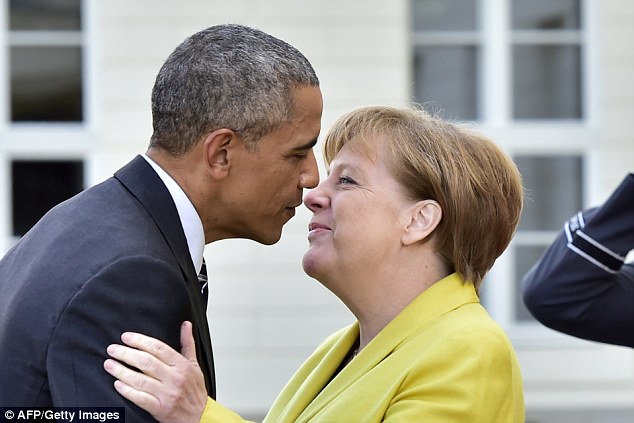
President Barack Obama and Chancellor Angela Merkel embrace as he arrives at the Herrenhausen Palace on Sunday
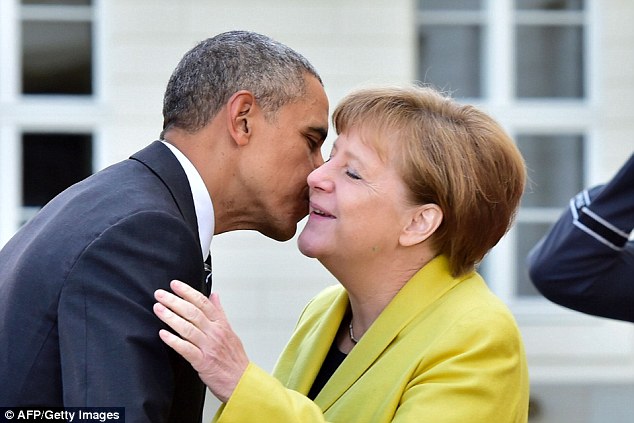
The pair will discuss the proposed US-Europe trade deal which has drawn ire in Germany
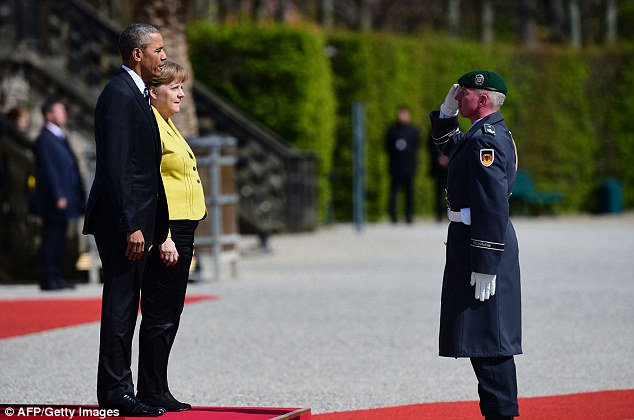
Obama also said they will discuss tackling ISIS and he will praise Merkel’s handling of the migrant crisis
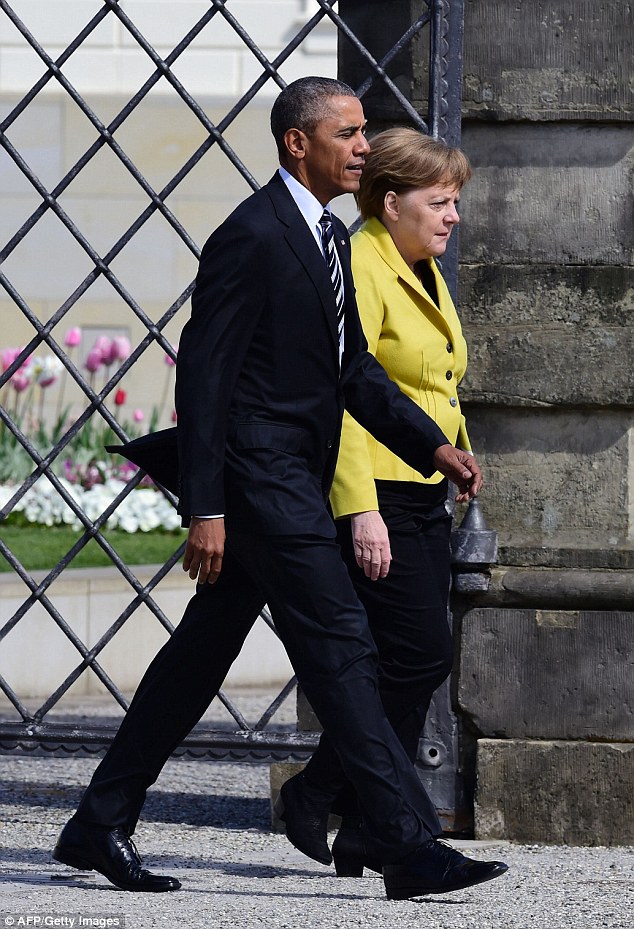
Together, Obama and Merkel launched the world’s largest trade fair in Hannover on Sunday
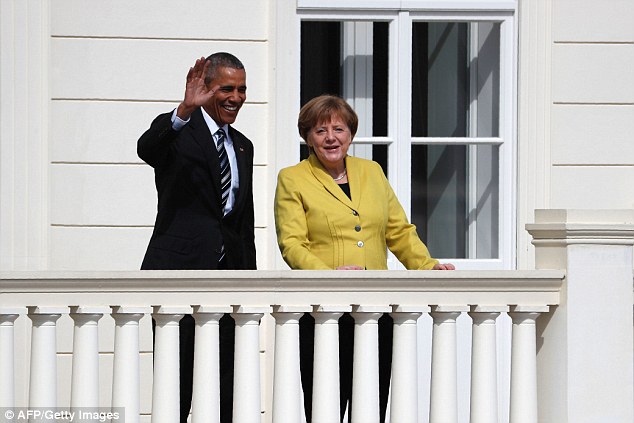
Obama waves at the crowds a day after thousands of people took to the streets to protest his visit
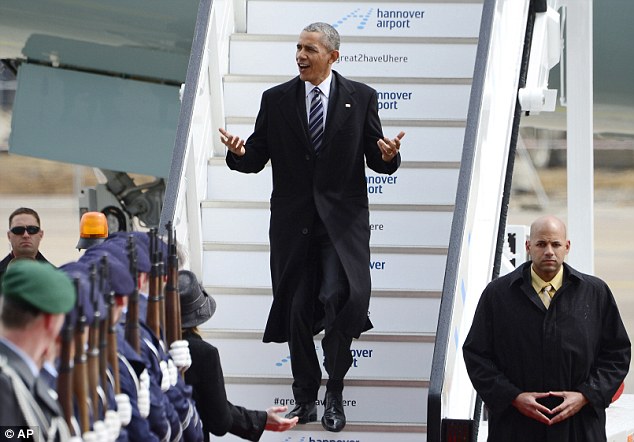
Touch down: President Barack Obama lands at the airport in Hannover, Germany, on Sunday morning
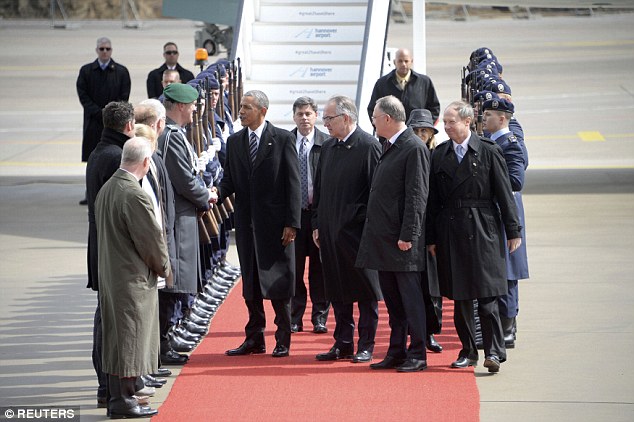
Obama touched down in the city on Sunday morning after a day of promoting the treaty in London
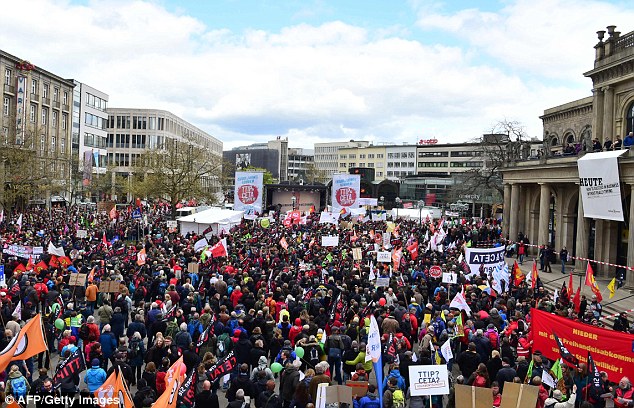
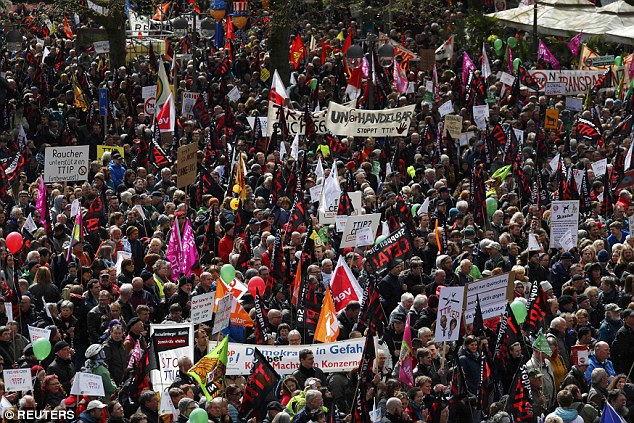
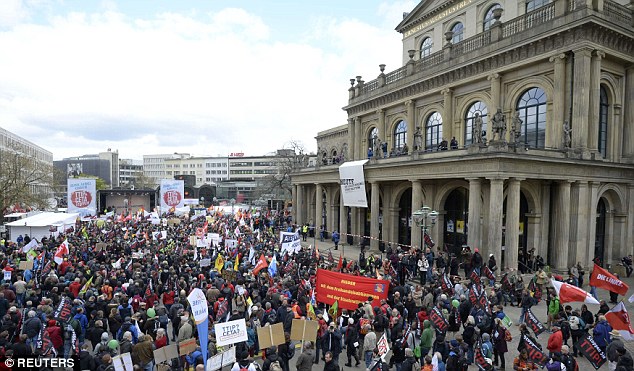
Thousands of demonstrators gathered in Germany to protest a planned free trade agreement between the U.S. and the EU, a day before President Barack Obama arrived
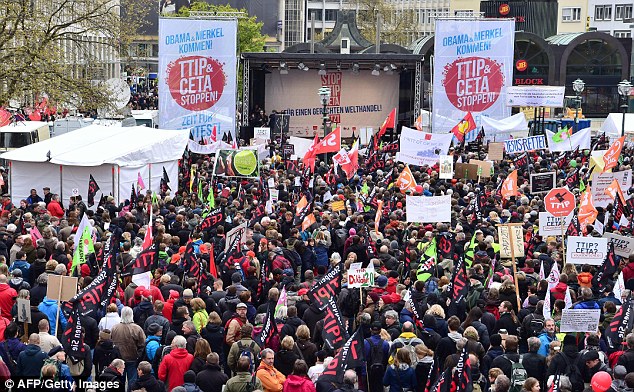
The streets of Hannover were crawling with activists who bitterly oppose the Trans-Atlantic Trade and Investment Partnership, or TTIP
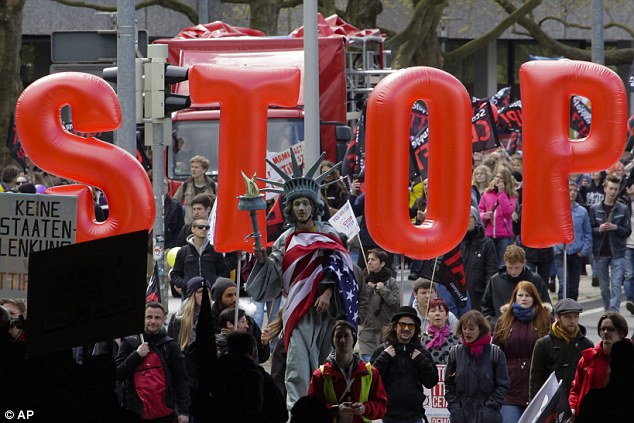
A man on stilts and dressed like the Statue of Liberty walks in front of balloons forming the slogan Stop TTIP during the protest
Thousands of people took to the streets in protest in Hannover on Saturday, the day before Obama arrived.
Some carried placards that said ‘Yes We Can – Stop TTIP!’ It was a riff on Obama’s 2008 presidential campaign slogan.
Organizers claimed that 90,000 people attended the demonstration in Hannover but police estimate the count was more like 30,000.
In November, more than 100,000 people in Berlin protested against the proposed pact.
Proponents say the deal would boost business at a time of global economic uncertainty. Critics fear the erosion of consumer protections and environmental standards.
Negotiators in Washington and Europe are trying to finalize key parts of the deal before the end of the year, after which Obama’s successor and election campaigns in major European countries could further complicate the already difficult negotiations.
The discussions, due to resume on Monday in New York, have come under criticism for the secretive manner in which they’ve been conducted.
National lawmakers are only allowed to view draft documents in special reading rooms and are forbidden from talking about the documents with experts, the media or their constituents.
Proposals to create dispute settlement tribunals have also stoked fears.
EU trade chief Cecilia Malmstrom envisages special investment courts that would rule in disputes between governments and companies that feel they face undue legal hurdles to their business.
Critics say such courts could place the interests of corporations above those of democratically elected governments, citing a recent case where tobacco giant Philip Morris sued Uruguay over a law requiring graphic warnings on cigarette packages.
Alfred de Zayas, an American law professor and U.N. human rights expert, argues that such courts are unnecessary in countries that abide by the rule of law, such as the United States or the EU’s 28 nations.
Backers of the special courts say they would prevent cases from being heard by American jurors who don’t understand the complexities of international trade law, and ensure that U.S. companies don’t face discrimination in European countries with high rates of corruption.
Juergen Hardt, a German lawmaker and the government’s coordinator for trans-Atlantic cooperation, believes some of those leading the fight against TTIP ‘have other motivations’ beyond trade.
‘They also want to incite anti-American feelings,’ he said.
https://youtu.be/A0Z7fcNpZts
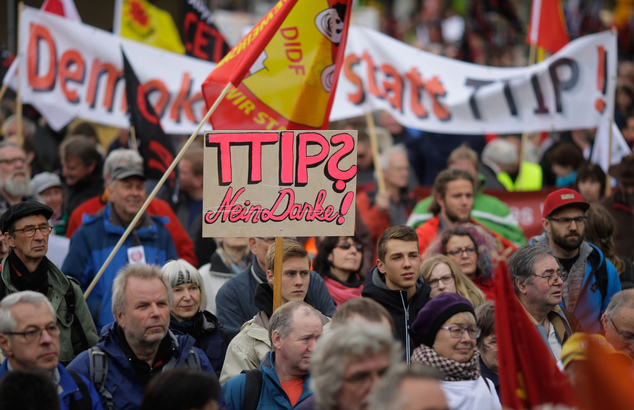 Germany Obama TTIP Protest
Demonstrators waved flags and carried placards with slogans such as ‘TTIP? Nein Danke (no thanks)!’
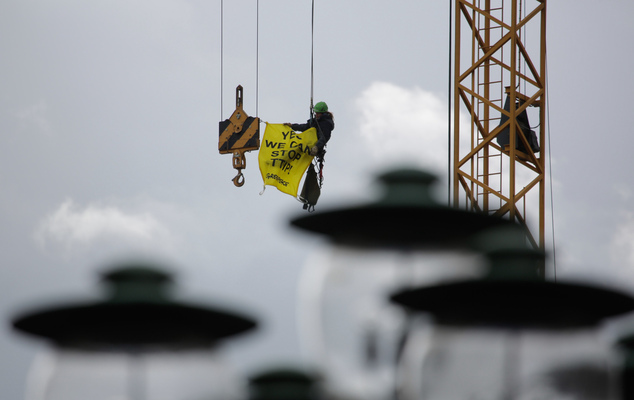
An activist of the environment organization Greenpeace with a banner reading ‘ Yes we can stop TTIP!’ hung from a building crane to show off his poster
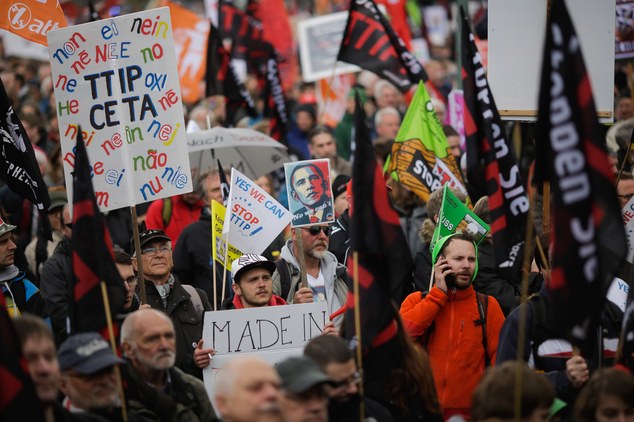
The streets of Hannover were crawling with activists who worry that TTIP is a deal favouring only big business
The EU’s executive branch is trying to promote the benefits of a deal.
On its website, it suggests that TTIP will boost demand for European delicacies like cheese, hams, wine, olive oil, spirits, and chocolate.
‘High tariffs at U.S. customs — up to 30 percent — make some of these hard for Americans to afford — and difficult for European farmers and firms to export,’ it says.
TTIP’s backers hope images of Obama in Europe — where his popularity remains high — will counter those of tens of thousands protesting the deal.
In her weekly video message Saturday, Chancellor Angela Merkel said everything has been done to improve the transparency of the negotiations — within reason.
And she stated anew that European standards won’t be eroded.
‘We are not falling behind our standards, but securing those we have in Europe today on the environment and consumer protection,’ she said.
Yet time may be running out for a deal. A spokesman for Germany’s Economy Ministry said that no draft proposals have been exchanged about numerous areas of negotiation.
The two sides are also divided about the issue of tariff reductions and the opening up of the markets for services and procurement.
‘In order to achieve negotiating success this year, it will be crucial to make significant progress by the summer on technical questions, so that the final negotiations are restricted to a few, politically sensitive areas,’ said Andreas Audretsch, the ministry spokesman.
Obama said it was important to conclude negotiations even though Congress is unlikely to ratify the deal before he leaves office.
https://youtu.be/PYIdYRoWYC0
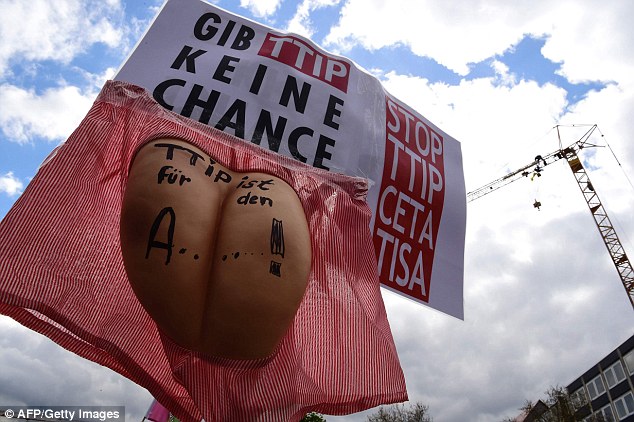
Opponents of a proposed transatlantic trade deal (TTIP) hold a banner reading ‘Don’t give TTIP any chance. Stop TTIP, CETA, TISA’ during a prostest rally on the eve of U.S. President Barack Obama’s visit
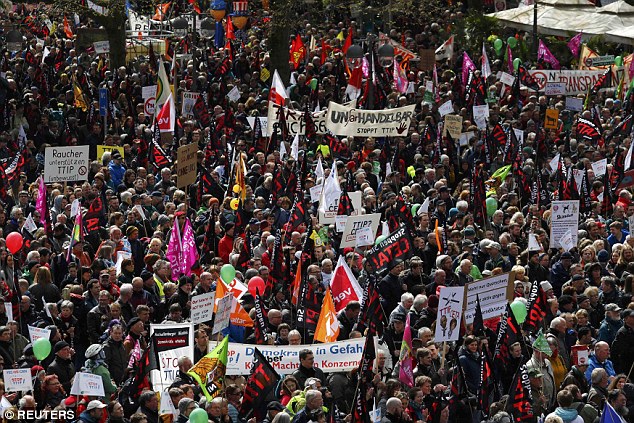
Protestors demonstrate against the Trans-Atlantic Trade and Investment Partnership (TTIP) free trade agreement
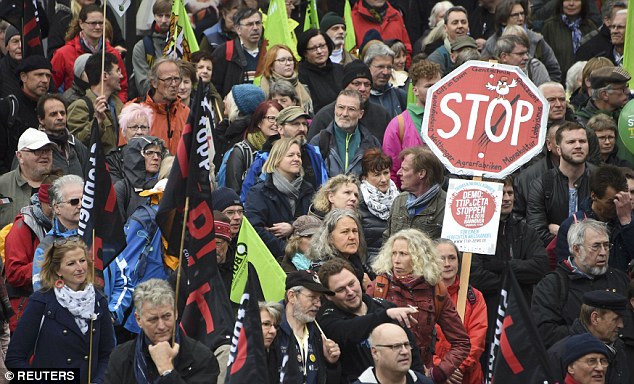
Officials in Washington and Brussels are trying to clinch key parts of the deal before the end of the year
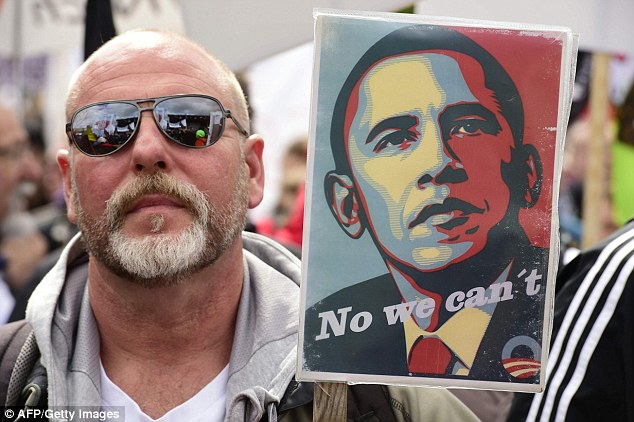
The discussions, due to resume on Monday in New York, have come under criticism for the secretive manner in which they’ve been conducted
Juergen Hardt, a German lawmaker, said the protesters ‘also want to incite anti-American feelings’
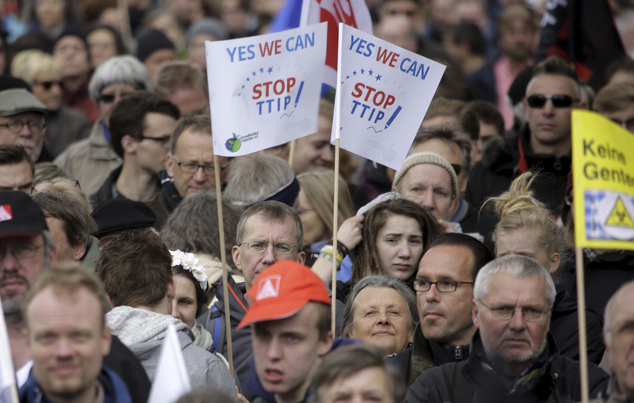
Protesters carried placards and waved flags with slogans such as ‘Yes We Can – Stop TTIP!’
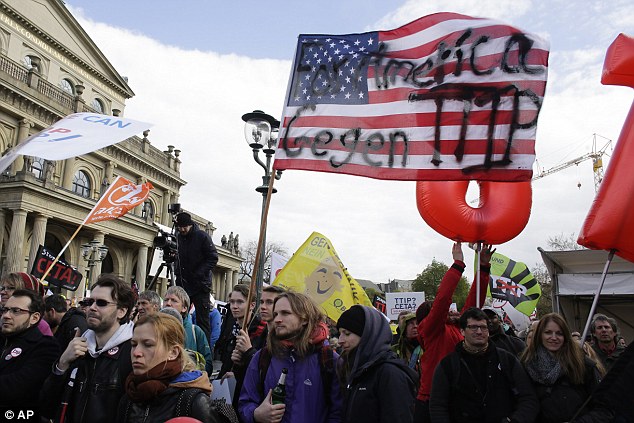
A man holds a United States flag with the slogan ‘For America Against TTIP’ during the protests in Hannover
‘But if we have that deal, then the next president can pick that up rapidly and get that done,’ he told the BBC in an interview broadcast Sunday.
In London on Saturday, he argued for the pact while acknowledging the tough work needed to complete it.
Despite ‘enormous amounts of trade’ between the U.S. and Europe, ‘there’s still barriers that exist that prevent businesses and individuals that are providing services to each other to be able to be able to do so seamlessly,’ he said.
The pact will bring millions of jobs and billions of dollars in benefits to both sides of the Atlantic, Obama said.
Negotiating trade deals ‘is tough,’ Obama said, because each country fights for its own interests.
‘The main thing between the United States and Europe is trying to just break down some of the regulatory differences that make it difficult to do business back and forth,’ he said.
Critics worry that it would erode consumer protection and environmental standards.
Merkel is the world leader with whom Obama has worked throughout his two terms, in good and bad times, and he planned to use the visit to show political solidarity.
Obama has said he wants to give Merkel public praise for her ‘courageous’ handling of the migrant issue.
Her decision to allow the resettlement in Germany of hundreds of thousands of people fleeing violence in Syria and other areas of conflict in the Mideast caused an angry domestic backlash.
Merkel recently helped European countries negotiate a deal with Turkey to help stem the migrant flow, but she and the other leaders are now under pressure to revisit it.
Merkel and top European officials traveled near the Turkish border on Saturday to promote the EU-Turkey migrant deal.
‘She’s demonstrated real political and moral leadership,’ Obama told the German daily Bild in an interview published Saturday. ‘The politics around refugees and immigration is hard in any country, but I believe the best leaders are willing to take on the toughest issues, especially when it’s not easy.’
Obama was likely to contrast Merkel with the Republican presidential candidates in the United States who want to block Muslims from entering America.
On Monday, Obama was to give a speech addressing the challenges facing the United States and Europe.
Merkel has used the occasion of Obama’s visit to invite the leaders of France, Britain and Italy to Hannover that day for a meeting expected to focus on Syria, Libya, IS, migration and other issues.
In her weekly video message Saturday, Chancellor Angela Merkel said everything has been done to improve the transparency of the negotiations
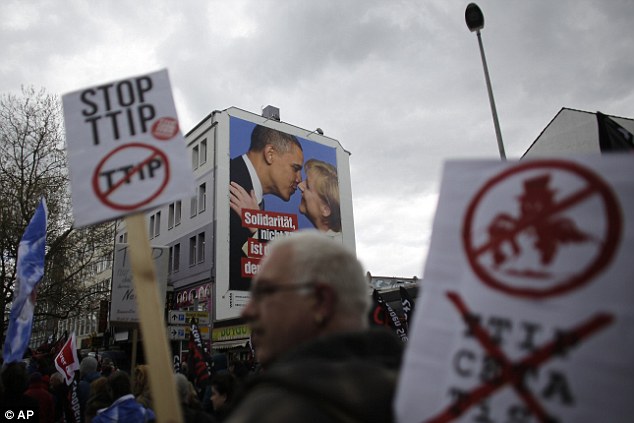
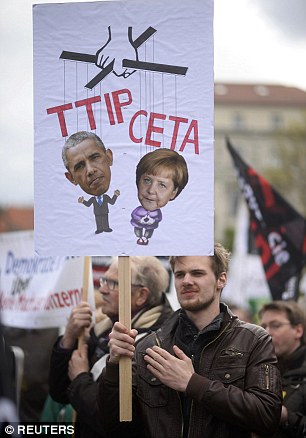
A man holds a poster with the slogan Stop TTIP as he passes a huge poster against TTIP with President Barack Obama and Chancellor Angela Merkel
President #BarackObama begins his two day visit to #Germany #Protesters https://t.co/PtQjcvZDrI pic.twitter.com/rV84PUPeLt
— Akademi Portal (@AkademiPortalEN) April 24, 2016