



Forget 3D printing! Here comes 4D: Shape-shifting objects that fold themselves up and change over time are created using a printer
The technique uses a ‘hydrogel ink’ that swells when it is added to water
By creating different patterns the object can fold into prescribed shapes
Scientists say it could be used to create medical implants or electronics
Three dimensional printing is about to become so passé – welcome to the world of 4D printing.
A team of scientists has created a technique for printing objects that can change their shape over time according to their environment.
The researchers said the structures created by the printer can shift their shapes when they are immersed in water, folding into complex and beautiful designs.
Scroll down for video
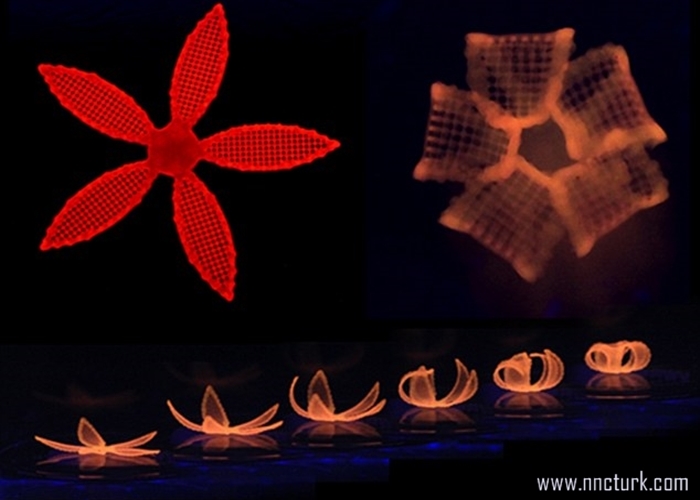
Scientists have created a technique for printing structures that can change shape when they are added to water. The researchers were inspired by flowers that change shape as their environment alters. In the example above a printed gel folds up like a flowers petals after being added to water (pictured)
However, it could also be adapted to print objects that fold into prescribed shapes upon heating, cooling or receiving an electrical current.
The researchers behind the technology said it could be used to generate new types of medical implants that fold into shape once inserted or generate soft electronics.
Dr Jennifer Lewis, senior author on the study at the Wyss Institute for Biologically Inspired Engineering at Harvard University, said: ‘This work represents an elegant advance in programmable materials assembly, made possible by a multidisciplinary approach.
‘We have now gone beyond integrating form and function to create transformable architectures.’
The researchers, whose work is published in the journal Nature Materials, were inspired by the way plants grow and change shape over time.
Flowers and plants have tissues with microscopic structures that mean their shape changes as their environment changes.
***
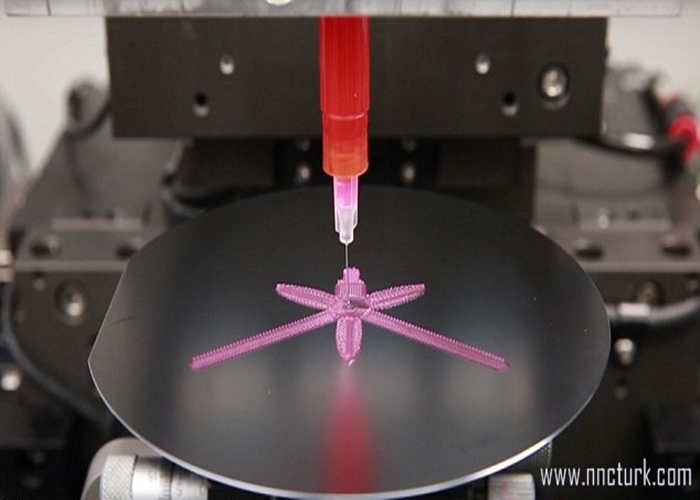
The technology uses a hydrogel ‘ink’ that contains cellulose and can be printed as a liquid before it solidifies (pictured). By carefully printing out microstructures, when the gel swells, it changes into prescribed shapes
It means that leaves can fold up and open, or tendrils and flowers will open in response to changes in temperature or humidity.
Dr Lewis and her team used a printable hydrogel that swells when it is added to water.
By designing specific structures they were able to control how the shape of the objects would change when they were added to water.
The hydrogel ‘ink’ was made containing cellulose fibrils which are derived from wood and are similar to the structures that allow plants to change shape.
Once printed, the gel solidifies and when it swells will alter the shape of the object in a prescribed way according to how the structure has been put together.
Dr Elisabetta Matsumoto, a research fellow who took part in the project, said: ‘Our mathematical model prescribes the printing pathways required to achieve the desired shape-transforming response.
‘We can control the curvature both discretely and continuously using our entirely tunable and programmable method.’
The team also claims it can alter the materials so they respond to different stimuli, meaning it may be possible to create objects that respond to electrical current or only fold up in certain biological environments.
‘Using one composite ink printed in a single step, we can achieve shape-changing hydrogel geometries containing more complexity than any other technique, and we can do so simply by modifying the print path,’ said Sydney Gladman, a graduate research assistant who also conducted the research.
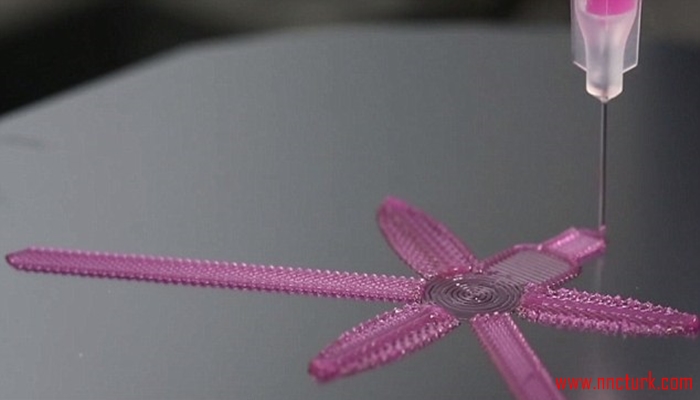
The researchers used mathematical modelling to work out what patterns of the ink (pictured) could cause the printed structure to fold in a certain way. By using 3D printing technology, it allows them to precisely control it
‘What’s more, we can interchange different materials to tune for properties such as conductivity or biocompatibility.’
Professor Lakshminarayanan Mahadevan, an applied mathematician at Harvard University, added that the technology promised to open up new ways of creating devices that mimic nature.
He said: ‘It is wonderful to be able to design and realize, in an engineered structure, some of nature’s solutions.’
Read more:
Share or comment on this article