


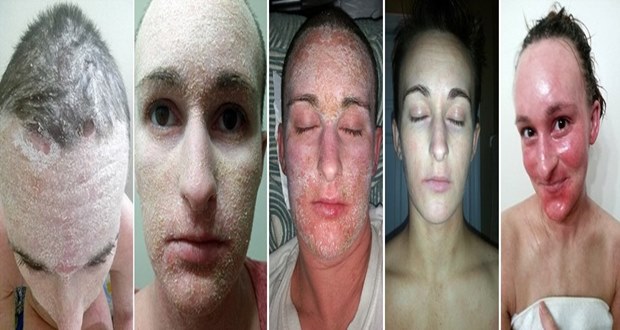
Eczema patient filled two jars with dead SKIN after suffering severe reaction when she stopped using topical steroid creams
- Briana Banos, 27, was diagnosed with topical steroid withdrawal
- Causes red, itchy, burning skin and intensifies original skin complaint
- Had to vacuum several times a day to get rid of the skin she was shedding
- Collected skin she shed to show possible risks of using steroid creams
An eczema sufferer was left feeling like a ‘human scab’ and shed enough dead skin to fill two pint jars after suffering a reaction when she stopped using steroid creams.
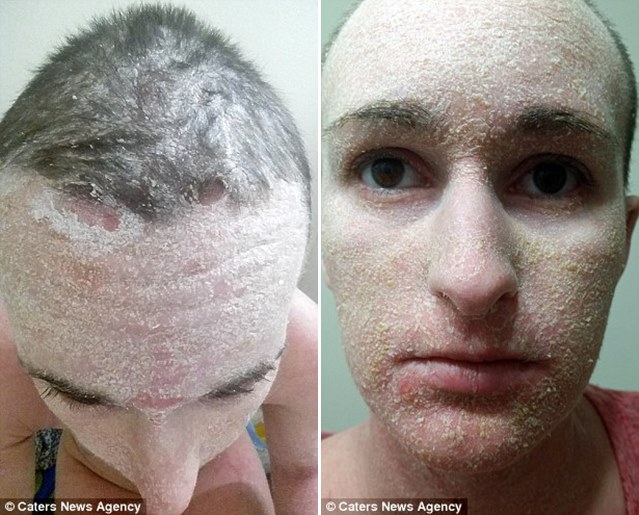
Briana Banos, 27, had to hoover several times a day to get rid of the skin she was shedding from her body
Briana Banos, 27, had to vacuum several times a day to get rid of the skin she was shedding from her entire body.
Her horrifying reaction started after she stopped using the topical steroid creams prescribed to treat her eczema for more than three years.
She was diagnosed with topical steroid withdrawal – also known as Red Skin Syndrome – which causes the original skin problem to escalate.
The simplest movements would make her skin shed and over seven months she swept up enough dead cells to fill two pint-sized jars.
She spent more than a year barely able to sleep without medication and would only leave the house occasionally because of the intense symptoms caused by topical steroid withdrawal.
Three months ago her skin started to recover and she has returned to work as an acrobat for the first time since quitting steroids.
‘At my worst skin would fall off wherever I walked, it was like being a human scab and one giant ball of crust.
‘I was shedding so much I had to vacuum my bed every morning to get rid of the dead skin.
WHAT IS RED SKIN SYNDROME?
——————————–
RSS or Red Skin Syndrome, also known as Topical Steroid Addiction (TSA) or Topical Steroid Withdrawal (TSW), is a debilitating condition that can arise from the use of topical steroids to treat a skin problem, such as eczema.
RSS can also arise from topical steroid use in individuals with no prior skin condition – such as with cosmetic use for skin bleaching or to treat acne, or in the case of caregivers who neglect to wash their hands after applying topical steroids on someone else.
Topical steroids are also called topical corticosteroids, glucocorticosteroids, and cortisone.
They come in many different preparations including creams, ointments, oils, gels, and lotions. Some are sold over-the-counter; others require a doctor’s prescription.
RSS is characterised by red, itchy, burning skin that can appear after ceasing topical steroid treatments, or even between treatments.
In RSS, topical steroids are effective for a period of time to treat the skin condition.
As time passes, however, applying topical steroids results in less and less clearing. The original problem escalates as it spreads to other areas of the body. In the case of eczema, this ‘progression’ is often mistaken for worsening eczema.
RSS is an iatrogenic condition, which means it is a condition caused inadvertently by a medical treatment.
Not everyone who uses topical steroids will develop RSS. It is unclear why some individuals experience RSS secondary to topical steroid therapy and why others do not.
Source: itsan.org