



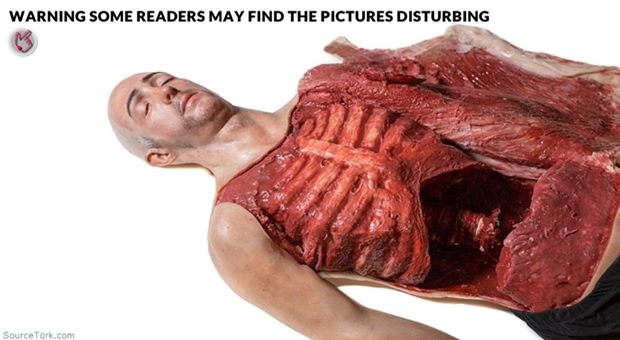
Creepy human replica could train future surgeons: 3D printed body that breathes and bleeds can recreate the trauma of emergency operations

*
The lungs can inflate and deflate giving the impression the replica body is really breathing
*
Artificial blood can also pump out of blood vessels to mimic the blood loss experienced by patients
*
The 3D printed patient will be provide hands-on experience for training military and civilian surgeons
—————————————————–
With the skin on his patient’s chest peeled back and their rib cage cracked open, Richard Arm reaches in and pulls out their heart.
For anyone who is even a little squeamish, it is a horrifying sight, except for one key detail – this ‘patient’ is actually a life-like 3D printed replica of a human being.
Carefully modelled on a real body, it has been created from a combination of silicone gels and fibres to mimic a real patient to help train surgeons.
Each of its organs have been printed using CT scans of real hearts, lungs and blood vessels while the face is modelled on a real person right down to realistic stubble.
Artificial blood can be pumped into the body to recreate the blood loss that occurs when surgeons cut into a patient and to give them experience of racing against the clock before they bleed to death.
Air can be pumped into the lungs so the inflate and deflate just like the patient is breathing.
HOW THEY MADE THE BODY
The researchers used CT scans to create 3D printed organs that look like the real thing.
Different grades of silicone were used to give the organs textures that are more realistic.
The lungs can inflate and deflate like they do in real life, giving the impression the patient is breathing.
Artificial blood can also be pumped out of blood vessels to mimic blood loss during operations.
The skin was made from resealable silicone so it can be cut and repaired.
The face is based on a real person and has been given stubble to make it more realisistic.
Even the chest can rise and fall as the ‘patient’ breathes while on the operating table.
It has been developed by Mr Arm, a research fellow at Nottingham Trent University, in an attempt to recreate the stress and feel of emergency trauma surgery for trainee doctors.
He said: ‘The aim is to allow trainee surgeons the psychological space to prepare for real life surgery using immersive environments and realistic representations of human anatomy.
‘Surgeons can be better prepared for live surgery by improving their surgical skills and enhancing post-operative outcomes for patients.’
The 3D printed patient was created in a project between the University’s school of art and design, the Ministry of Defence’s Royal Centre for Defence Medicine and the Queen’s Medical Centre in Nottingham.
Each of the organs has been engineered to have the same feel as the real thing, so different parts of the heart have different levels of hardness.
The outer skin – created by causality simulation firm Trauma FX – can be cut with a scalpel and then seamlessly resealed for repeated mock surgeries.
A limited supply of artificial blood can be pumped into the body to provide the experience of operating against the clock, before a fatal level of blood-loss occurs.
Tests will now be conducted on the prototype to see how it can be improved while the team also plan to create other life-like organs including the brain, eyes, stomach, liver, pancreas and kidneys.
They may also recreate the vascular system for a person’s legs.
Colonel Peter Mahoney, emeritus professor of anaesthesia, at the MoD’s Defence Medical Services, said it could transform how military surgeons are trained to deal with battlefield traumas.
https://youtu.be/ugg0AZvMmQ0
‘The ability to place clinically realistic surgical and anaesthetic training models into simulations of austere military environments is of great value to military medicine,’ he said.
‘As well as providing a training platform for our surgical teams, the thoracic trauma trainer will be of benefit to our prehospital Medical Emergency Response Teams.’
The MoD is expected to take delivery of two of these silicon ‘patients’ in 2017 to begin training their staff on them.
Professor Tilak Dias, a supervisor of the project at Nottingham Trent University, said: ‘By enhancing the learning experience of surgeons, we can ensure they are better prepared for real life situations where their skills and knowledge are relied upon to save people’s lives.’
powered by Akademi Portal